FAMILY SYSTEM · PEOPLE BEFORE THE CAR
The Family Roadside-Breakdown Plan: Get Clear, Stay Buckled, Call for Help
The first job is not diagnosing the engine. It is getting every person out of moving traffic, keeping children controlled and giving responders a precise location.
The five-step family sequence
- Control: keep steering, brake smoothly and avoid abrupt lane changes.
- Clear: if the vehicle can move safely, get fully out of the travel lane to the safest available refuge.
- Signal: activate hazard flashers and follow lawful emergency guidance.
- Contain: keep children buckled and account for every person.
- Communicate: call 911 for immediate danger or injury; otherwise contact the roadway authority, roadside provider or tow service with precise location details.
This is a decision framework, not a universal command to stay in or exit the vehicle. Fire, smoke, rising water, a vehicle exposed in a travel lane, unstable ground or instructions from responders can change the safest action immediately.
If the vehicle still moves
Signal, reduce speed smoothly and aim for the widest safe location available. Avoid stopping just beyond a blind curve, crest or narrow bridge when you can safely reach a better refuge. Do not continue far enough to turn a manageable mechanical warning into loss of steering, braking, tire control, fire or major engine damage. Follow the vehicle manual for red warnings and stop-engine messages.
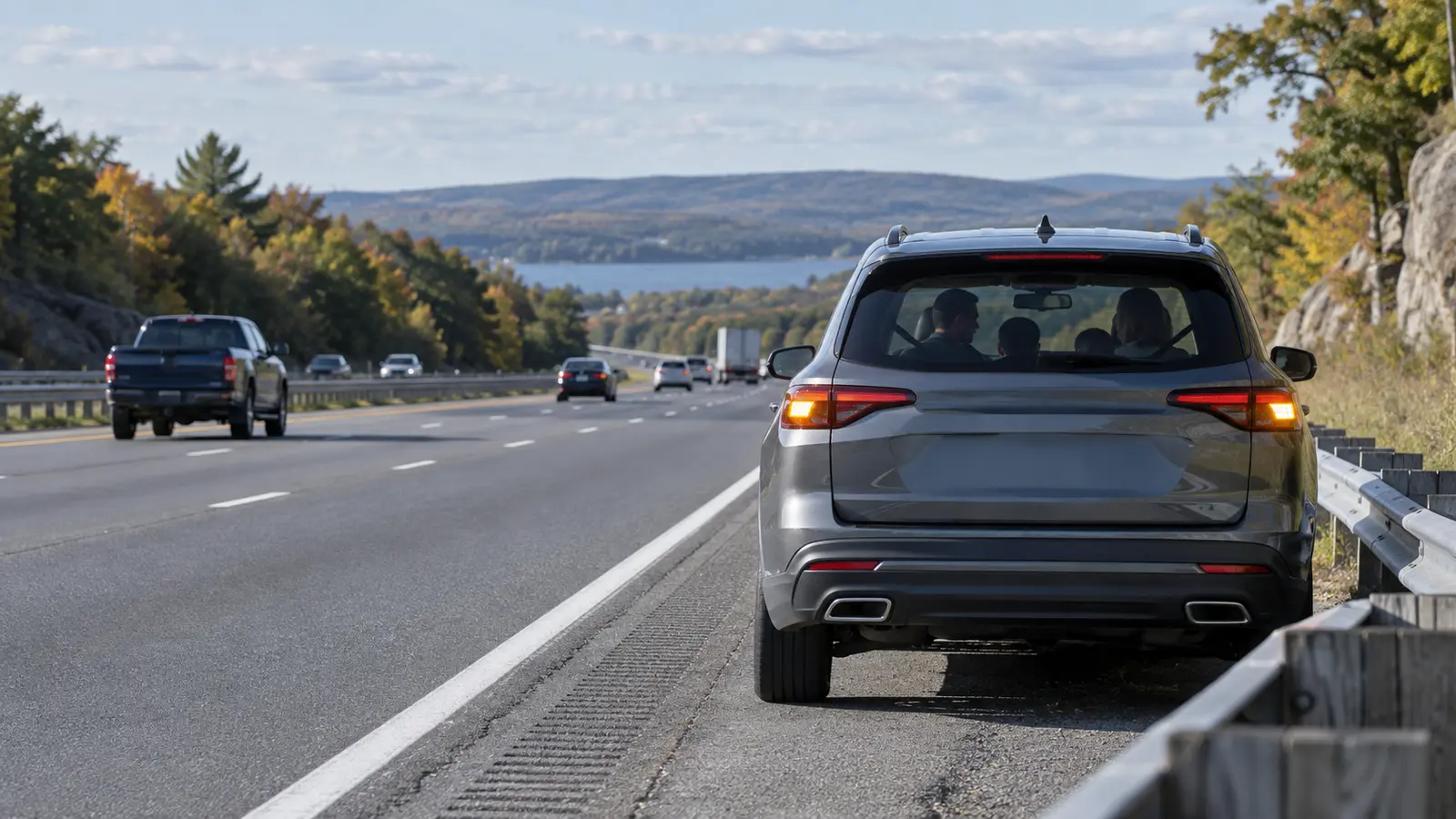
On the New York State Thruway, official guidance says to move the vehicle as far off the roadway as possible, activate four-way flashers and stay with the vehicle while waiting for help. The Thruway's emergency assistance page is the authority for that road; local roads, bridges and work zones can require different action.
If the vehicle stops in a live lane
Turn on hazards and call 911. Give the route, direction of travel, nearest exit or mile marker, lane position, vehicle description, number of people and any injury, smoke, fuel smell or other immediate hazard. Keep seat belts on unless remaining creates a more immediate danger or responders direct otherwise.
Do not send an adult or child walking along a high-speed roadway for help. Do not stand behind the vehicle, open traffic-side doors, or unload bags while traffic passes. A phone call with an imperfect location is better than a family spreading out to search for a sign.
Stay in or get out?
Usually stay contained when the vehicle is fully clear of traffic, there is no fire, smoke, fuel leak, water, unstable shoulder or other immediate hazard, and official guidance supports staying. Children remain buckled on the side farthest from traffic where seating allows.
Exit only for a stronger danger such as fire, visible smoke, rising water, an unstable position, or explicit instruction from emergency personnel. If evacuation is necessary, use the side away from traffic when possible, take children under direct adult control and move far from travel lanes behind a substantial barrier or to another clearly safer place. Never cross active highway lanes.
The driver script
Before the trip, teach one sentence: “The car stopped; stay buckled and wait for the adult.” The passenger adult, when present, handles the phone and children while the driver controls the vehicle. If one adult is alone, stop speaking to roadside services until the vehicle is in the safest position available.
Use the no-service day-trip plan to keep route, destination and emergency details available offline. Screenshot or write down the roadside-assistance number before remote drives. A membership card buried in email is not available when the phone has no data.
What to tell help
- Road name or route number and travel direction.
- Nearest mile marker, exit, intersection, landmark or GPS coordinates.
- Whether the vehicle is in a lane, shoulder, ramp, parking area or behind a barrier.
- Vehicle color, body type and license plate.
- Number and ages of occupants.
- Injury, disability, medical need, smoke, fire, fuel odor, flat tire or loss of electrical power.
- Whether traffic, weather or terrain makes the location immediately dangerous.
Do not diagnose beyond what you can observe safely. “The engine made a grinding sound and stopped” is useful. “The alternator is definitely dead” may send the wrong equipment.
Roadside repairs: the hard boundary
A tire kit, jump pack or inflator does not make every shoulder a safe work area. High-speed traffic, narrow shoulders, slopes, soft ground, weather and poor visibility can make even a familiar repair unacceptable. Move to a safer location or wait for professional help when exposure is the bigger risk.
Never crawl under a vehicle supported only by a jack. Never work near moving traffic, leaking fuel, smoke or fire. Follow the exact vehicle manual for jacking points, spare-tire limits, towing, jump starting and warning lights. Use the tire-inflator guide for slow leaks and pressure checks—not as permission to drive on damaged tires.
The family roadside kit
Pack a charged phone, vehicle charger, paper contact card, reflective vest for adults, flashlight, weather layer, water, simple snacks, first aid and any essential medication. Warning devices must comply with local law and be deployed only when an adult can do so without entering traffic. Do not hand children flares, triangles or tools.
Keep the kit reachable without unloading the cargo area into the shoulder. The winter car kit adds cold-specific supplies; the family power guide covers phone capacity without pretending a battery fixes coverage.
Weather and night
Rain, snow, heat, darkness and low visibility all shrink the margin. Stay visible without standing in traffic. Conserve phone power after the call, but keep the device available for responders. In extreme heat or cold, tell dispatch about children and any medical vulnerability; do not wait silently while cabin conditions become dangerous.
After the vehicle is recovered
Confirm every person and item is inside the recovery vehicle before it moves. Photograph the tow company's name and destination if safe and useful. Ask where the vehicle will be stored, what identification is needed and whether passengers can ride in the tow truck; capacity and child-restraint arrangements vary, so do not assume.
Have the cause inspected by a qualified technician. A warning light that disappeared after a restart is not proof the problem is resolved. Restock water, chargers and any used safety gear before the next trip.
Who should not improvise
Families with children, mobility needs, roadside medical risks or a vehicle partly exposed to traffic should call for help early. Skip DIY diagnosis when the manual forbids continued operation, when fire or fuel is possible, when visibility is poor, or when the repair would place any person near moving traffic. The goal is not heroic self-reliance. The goal is everybody home.
Official sources
- New York State Thruway emergency and roadside assistance
- Official Thruway travel map and conditions
- FHWA disabled-vehicle incident guidance
- NHTSA seat-belt guidance
- Official 511NY road conditions
MAKE THE WEEKEND COUNT
Useful beats heroic.
Build the day your family can finish well, then leave enough energy for the ride home.
More family plans