ROAD GEAR · MANUAL BEFORE CLAMPS
Family Car Jump Starters: Lithium Pack vs Jump Box vs Cables—and the Manual-First Rule
The best jump-start tool is compatible with the exact vehicle, charged when needed and never used where traffic, damage or uncertainty makes opening the hood the wrong move.
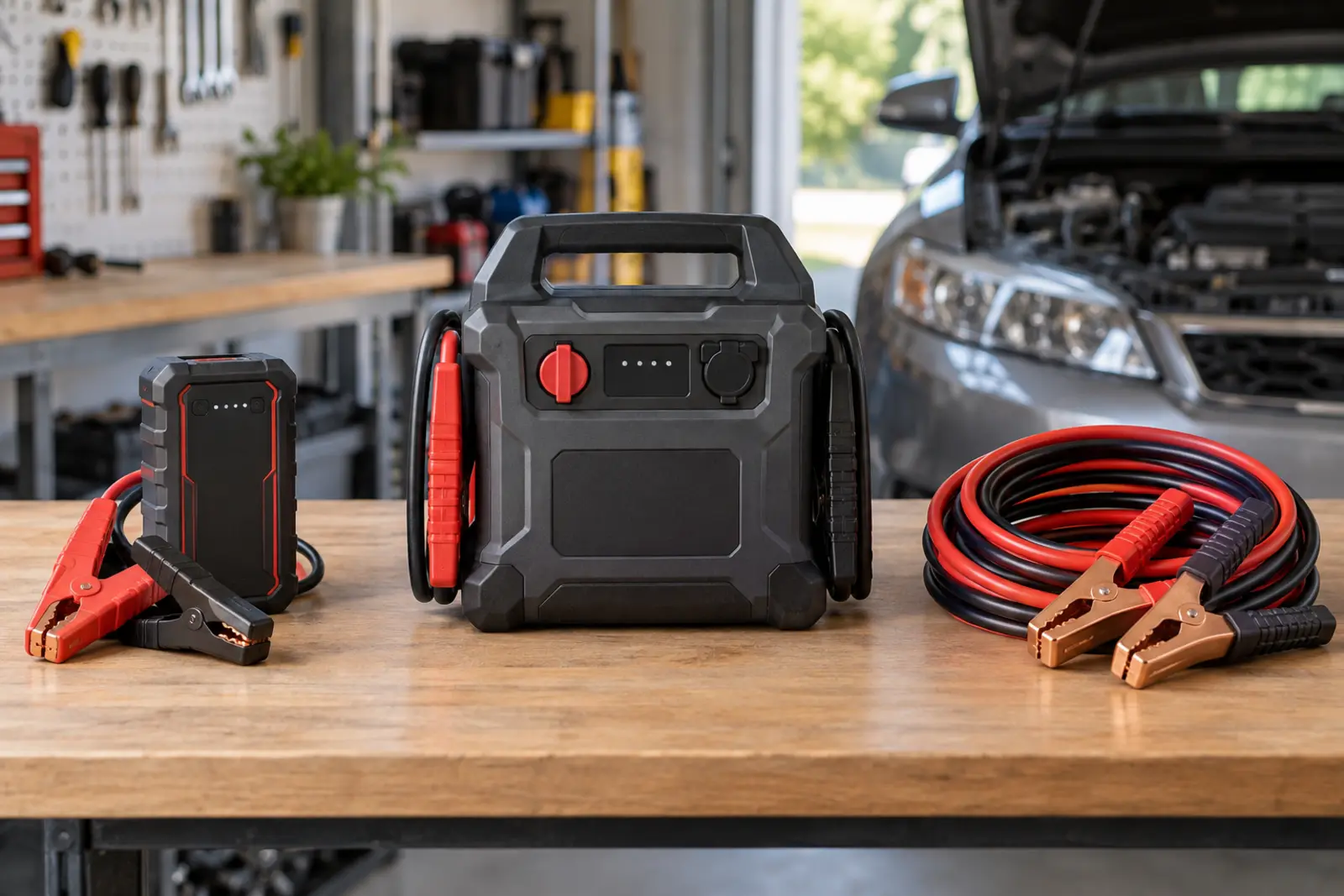
Three tools, three dependency models
A compact lithium jump pack carries its own energy in a small rechargeable battery. A larger portable jump box usually trades size and weight for larger clamps, more cable reach, a different battery chemistry or additional service features. Jumper cables carry no stored energy at all; they require a compatible donor vehicle, correct positioning and two vehicles whose manuals permit the procedure.
None is a universal winner. A small pack that cannot support the vehicle, a heavy box that is never charged and premium cables with no safe donor position are all dead weight. Start with the family’s actual vehicles, climate, routes, storage habits and willingness to perform maintenance.
Gate one: the exact owner’s manual
Search the manual for “jump starting,” “12-volt battery,” “emergency starting” and the exact model year. Some vehicles provide remote positive and negative connection points instead of direct battery access. Some hybrids and electric vehicles have a conventional low-voltage battery but restrict how it may be supported or whether the vehicle may serve as a donor. A high-voltage traction system is not a family DIY jump-start target.
Record the system voltage and designated connection points on a paper card kept with the device. Do not assume every passenger vehicle uses the same voltage or connection order. The vehicle manual and the jump device’s own manual must agree; when they do not, stop and contact the vehicle manufacturer, roadside assistance or a qualified technician.
The comparison
Compact lithium jump pack
Fits: families who want a small self-contained option and will maintain its charge. Tradeoffs: storage temperature, battery aging, charge state and model-specific protection logic matter. Engine-size marketing is not enough; confirm voltage, supported engine, clamp design, cable reach, certification mark, operating range and the maker’s instructions.
Lithium packs can be simple when correctly connected, but “manual override” or forced-boost modes intentionally bypass normal protections on some products. Do not use that feature because a light will not turn green. It belongs only inside the exact manufacturer procedure when the operator understands the hazard and the vehicle manual permits it.
Larger portable jump box
Fits: car-base travel where size is less important and larger clamps or longer leads solve a real access problem. Tradeoffs: it takes more cargo space, may be awkward to move safely, and still needs scheduled charging and inspection. A heavy case does not prove stronger starting performance or safer electronics.
Ask what battery chemistry is inside, how the state of charge is checked, whether the internal battery is replaceable or serviceable, where the unit can be stored, and what its end-of-life instructions are. If the unit also powers appliances or includes an inflator, judge each function separately. A bundle of features is not a substitute for a reliable jump-start circuit.
Jumper cables
Fits: drivers who understand the procedure, have manuals for both vehicles and can position a permitted donor safely. Tradeoffs: donor dependence, traffic exposure, polarity risk and cable routing. Gauge labels alone can be misleading without length and conductor material. Longer cable adds reach but also electrical resistance; the correct choice must still meet the vehicle maker’s guidance.
Cables are not the cheap default when one family member would need to flag down a stranger, move children between vehicles or place two cars nose-to-nose beside traffic. The family roadside-breakdown plan comes first: get clear of moving traffic when possible, keep children buckled in the safest available location and call for help.
What specifications actually matter
- Vehicle compatibility: exact system voltage, fuel type, engine size and approved connection points.
- Starting support: use the manufacturer’s supported-engine table, not a marketplace peak-amp headline by itself.
- Clamp geometry and cable reach: the clamps must reach and securely engage the designated points without resting against moving or hot parts.
- Protection and status indicators: reverse-polarity warning, connection detection and clear charge state help, but only within the instructions.
- Independent safety certification: UL identifies UL 2743 as a standard that covers portable power packs including automotive jump starters. Verify the listing and exact model with the certifying organization; a logo-shaped mark in a product photo is not proof.
- Storage limits: compare the maker’s allowed charge and storage temperatures with the actual vehicle environment. A closed car can become extremely hot or cold.
- Recharge plan: choose an interval the family will actually follow and confirm charge before long trips.
- Recall and support path: identify the manufacturer, model and serial information, and check the CPSC recall database.
The no-open-hood gate
Do not begin when the vehicle is exposed to fast traffic, the road surface is unstable, visibility is poor, fuel or battery odor is present, the battery case is cracked, leaking, bulging or frozen, cables are damaged, the voltage is unknown, or children cannot remain safely clear. Turn on hazard warning lights when appropriate, follow local emergency guidance and call 911 for immediate danger.
Do not let a child hold clamps, operate override controls, stand between vehicles or watch from the engine bay. The adult doing the work should remove loose jewelry, keep flames and smoking away, wear eye protection when the manuals call for it, and avoid leaning over a battery. These are not instructions for a live connection; the two manuals supply that sequence.
The quarterly maintenance drill
- Inspect the case, clamps, insulation, plugs and charge cable under good light.
- Check state of charge and recharge only with the approved equipment in the approved temperature range.
- Confirm the device still matches the family vehicle list.
- Open the vehicle manual to the jump-start page and verify the paper note still matches.
- Check the manufacturer’s safety notices and the CPSC recall database.
- Store the device restrained and accessible, not under every suitcase and not loose beside children.
Add the check to the winter car-kit reset. Cold weather can expose weak batteries and reduce portable-battery performance, while summer heat can violate storage limits. The tire-inflator guide uses the same rule: accessories do not override the vehicle manual.
What not to buy
- An untraceable marketplace unit with no accessible manual, manufacturer address, model number or recall path.
- A pack chosen only by the largest “peak amps” number.
- A device with clamps too short or too bulky for the designated jump points.
- A battery pack whose permitted storage temperature does not fit the vehicle routine.
- Cables that would require unsafe donor positioning on the routes you drive.
- A used jump pack with unknown battery, heat, drop or charging history.
- A model marketed for 12- and 24-volt systems when the operator could easily select the wrong mode.
Cost and the honest buying decision
Spend first on compatibility, a real manual, traceable certification, usable clamps and a maintenance plan. A compact pack often wins for space; a larger box can win on access and serviceability; cables can be a durable backup when donor use is permitted and safe. The paid links below compare categories, not winners. No hands-on testing, current price, stock, rating, lifespan or start-count claim is made.
Do not buy any of them if the family will not maintain the device or if roadside assistance is the safer realistic plan. Put the saved money toward vehicle battery testing and preventive maintenance from a qualified shop.
Primary and manufacturer sources
- UL Solutions: portable power packs and UL 2743 scope
- NHTSA vehicle recall lookup
- CPSC consumer-product recall database
- Example manufacturer instructions showing model-specific limits
- Example vehicle owner’s manual with vehicle-specific jump-start procedure
MAKE THE WEEKEND COUNT
Useful beats heroic.
Build the day your family can finish well, then leave enough energy for the ride home.
More family plansTHE USEFUL STUFF
Gear that removes friction.
These are practical categories to compare—not a reason to overpack. Check fit, specifications and current reviews before buying.
Paid links: As an Amazon Associate I earn from qualifying purchases. You pay no additional cost.
Lithium vehicle jump starters
Verify the exact vehicle voltage, supported engine, clamp reach, storage range, certification and the manufacturer’s recharge instructions.
See current options → COMPARE ON AMAZONLarger portable jump boxes
Compare battery chemistry, loaded weight, cable reach, charge-state display, service path and vehicle compatibility.
See current options → COMPARE ON AMAZONHeavy-duty jumper cables
Confirm conductor material, gauge, length, clamp geometry and that both vehicle manuals permit the donor procedure.
See current options →