DAD SYSTEM · THE DANGEROUS TRANSFER
The Family Parking-Lot Plan: Unload, Regroup, and Leave Together
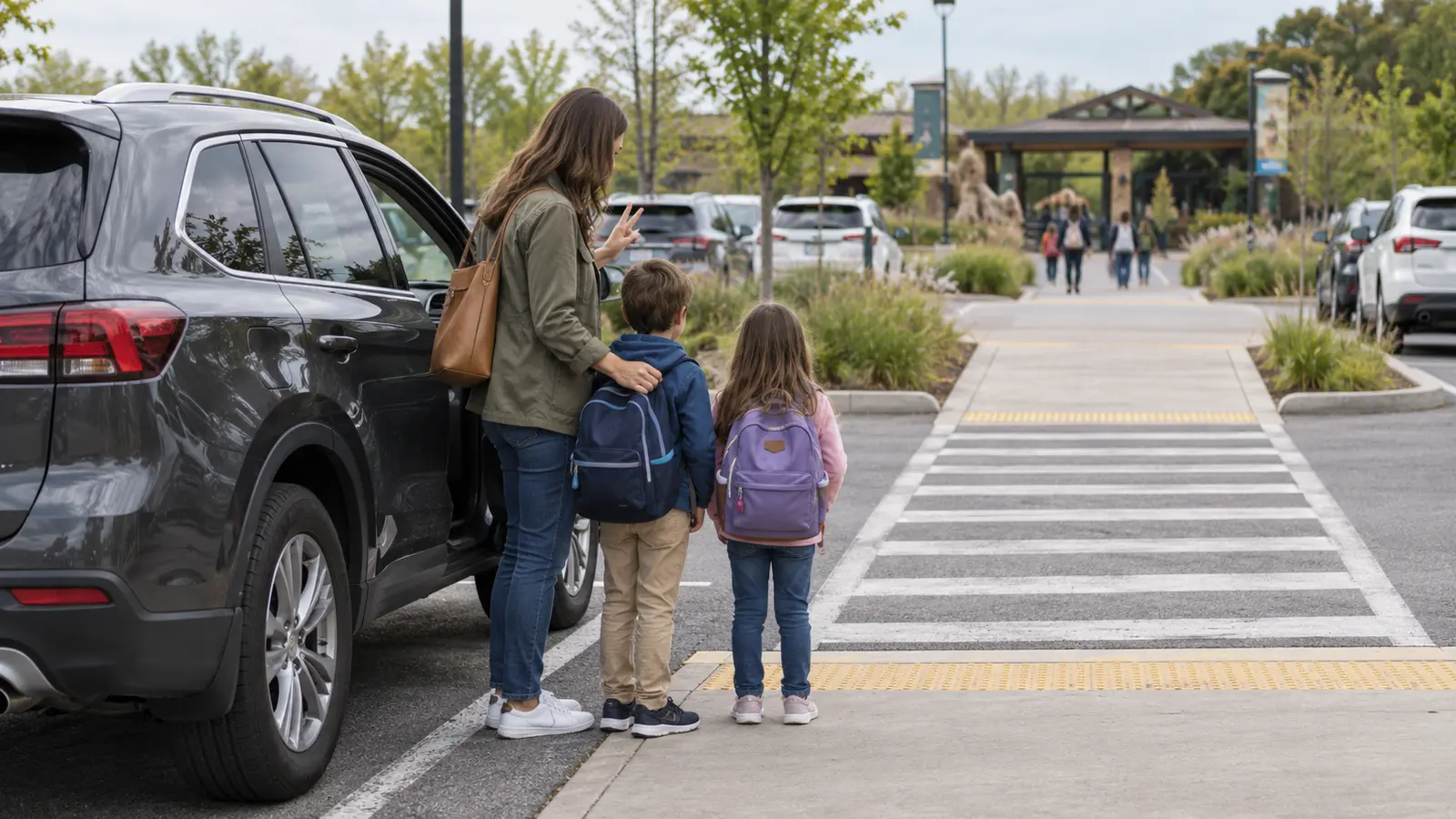
The adventure does not start at the entrance. It starts between two parked cars, where one adult is holding bags and a child thinks the sidewalk is already theirs.
Why the parking lot gets its own plan
Parking lots combine reversing vehicles, sight lines blocked by SUVs, carts, excited children and adults whose hands are full. NHTSA says backover incidents often occur because a driver leaving a driveway or parking space does not see an unattended child. Its pedestrian guidance specifically tells walkers to watch for vehicles entering, exiting or backing in parking lots.
The response is not fear. It is one repeatable transfer that removes improvisation. School-age children can learn the sequence and still require adult supervision. The plan also covers the return trip, when attention and patience are lower.
The arrival sequence
1. Park before anyone unbuckles
The vehicle must be fully stopped in the space, transmission in park and engine handled according to the owner's manual before doors open. The adult names the exit side. Use the side away from moving traffic when the space and vehicle allow it, but do not promise a “safe side” without looking: a curb can border a bike lane, drop, snowbank or active driveway.
Children wait buckled until the adult says who exits and where that child stands. A child who opens a door into a neighboring space can step into a moving vehicle's path or strike another car.
2. People before cargo
Move children to the designated regroup point under direct adult control. Good points are the passenger-side body panel beside the supervising adult, a protected sidewalk or another location outside the travel lane. “By the car” is too vague; specify the exact door or curb.
Only after every child is accounted for does the adult remove the stroller, wagon, cooler or bags. If there are two adults, one owns people and one owns cargo. Do not switch roles silently.
3. Count, name the leader, move
Say each child's name, make eye contact and give the route: “Together to the white crossing; I lead.” Younger or impulsive children stay physically connected to the adult as appropriate. Older school-age children walk close enough to stop on one instruction.
Do not weave diagonally between rows because it looks shorter. Use sidewalks and marked pedestrian routes when available. NHTSA advises crossing at corners or intersections, staying alert and watching for backing cars. In a parking lot, moving wheels and reverse lights are warnings, not invitations to hurry behind a vehicle.
The return sequence
1. Stop before the last row
Regroup before entering the parking aisle. Put phones away, finish the snack and assign the same person/cargo roles. If one child is melting down, pause at the protected edge. The car is not going anywhere.
2. Load children, then cargo
Keep every child with the supervising adult until their door is open. Seat and buckle each child in the correct restraint for that child and vehicle. Close the door, then load gear without leaving another child standing in the lane. The day-trip packing system helps by giving every bag a home instead of rebuilding the trunk beside traffic.
If a folding wagon or stroller must be collapsed, keep children in the vehicle or with the people adult—not orbiting the hinges. Use the folding-wagon guide for cargo and passenger distinctions.
3. The whole-vehicle check
Before locking or driving, check every seating row and the cargo area. NHTSA's heatstroke guidance says never leave a child unattended in a vehicle for any length of time, and to check the entire vehicle—especially the back seat—before locking and walking away. Parking in shade or cracking windows does not make leaving a child safe.
After unloading at home, lock the empty vehicle and store keys out of children's reach. This also reduces the risk of a child entering and becoming trapped.
4. Walk around before backing
NHTSA recommends checking around the vehicle before backing and backing slowly while continuing to look. Cameras and sensors are aids, not permission to skip the walk-around or mirrors. If visibility is poor or a child is not accounted for, the vehicle does not move.
The ten-second child script
Teach one short sequence: Wait for the word. Stand at our door. Walk with our adult. Never go back alone. Practice in a quiet lot without adding a lecture. The goal is a behavior the child can repeat while excited.
Pair it with the lost-kid plan: if separated near the destination, the child goes to a uniformed employee or another clearly identified helper and does not search the parking lot.
One adult, multiple children
Park where the route is shortest and most protected, even if the space is farther from the door. Unload the child who can wait safely last. Keep the adult's dominant hand free by using a backpack instead of a loose tote. A cart can carry cargo after the children are positioned; it does not supervise them.
If one child needs physical assistance while another bolts, the parking-lot transfer may require a second adult, curbside drop-off where lawful, accessible parking when eligible, or a different destination. The plan should match the actual supervision demand.
Night, rain and snow
Darkness: use well-lit pedestrian routes and reflective or bright outer layers; do not assume drivers see a small child. Rain: open umbrellas only after everyone is out of the door zone and visible. Snowbanks: treat them as sight-line barriers and avoid climbing or playing near traffic. Ice: shorten steps and do not pull a child behind you at speed. Heat: load people promptly, but never trade speed for an incomplete count.
The weather-cutoff plan begins before leaving the lot. If lightning, ice or visibility makes the transfer unsafe, wait in the vehicle or leave.
The cart-return problem
Never leave a young child alone in the vehicle while returning a cart, and never send a child through the lot alone to do it. Choose a space near a cart corral when that helps, return the cart before loading children when another adult remains with them, or keep children with the adult for the return. The correct sequence depends on supervision, not convenience.
Meltdown backups
A child runs ahead: stop the entire group and reset at the car or curb; do not chase while dropping gear. A bag spills: people remain the priority; move to a protected place before collecting ordinary items. You cannot find the car: stay on the pedestrian route and use the phone or staff for help; do not fan out. A child is unaccounted for: no vehicle moves—alert staff or emergency services according to the situation.
Who needs a stricter version
Families with a child who bolts, has limited hazard awareness or needs mobility support should build a specific transfer with their clinicians or support team when appropriate. A generic script cannot replace individualized supervision or accessible-route planning. Anyone too impaired, distracted or fatigued to drive safely should not start the vehicle.
Official safety sources
- NHTSA child safety and backover guidance
- NHTSA pedestrian safety
- NHTSA Stop. Look. Lock. heatstroke prevention
- CDC pedestrian safety overview
MAKE THE WEEKEND COUNT
Useful beats heroic.
Build the day your family can finish well, then leave enough energy for the ride home.
More family plans