DAD SYSTEM · WEATHER DECISIONS
The Family Outdoor Weather Cutoff Plan: Go, Shorten, or Leave
A forecast is not a dare and a warning is not a negotiation. Decide the family's go, shorten and leave conditions before the car leaves the driveway.
Why families need a cutoff, not forecast theater
A percentage icon cannot describe every hazard along a route. The useful questions are where the family will be, how exposed the activity is, how long retreat takes and what official alerts say. A paved zoo loop near buildings tolerates uncertainty differently from a gorge, open beach, boat or ridgeline.
This framework does not create universal medical or meteorological thresholds. It turns authoritative information into a family decision while there is still time to choose. A child's health plan, destination closure, ranger direction or local emergency message always outranks a generic checklist.
The family day-trip system organizes food and timing. This page decides whether the outdoor version should exist at all. The rain-gear guide handles getting wet; it does not make lightning, flash flooding, extreme heat or hazardous air safe.
The three checks
Check one: 24 to 48 hours before
Open the National Weather Service point forecast for the destination, not only the forecast for home. Read the written period description, hourly trend and active watches, warnings or advisories. Check AirNow for forecast air quality. Find the destination's official alert or closure page and identify a real indoor or lower-exposure replacement.
This is when booking flexibility matters. Read cancellation, weather and change policies before purchasing. Prefer a refundable reservation when weather sensitivity is high and the price difference is reasonable. Screenshot nothing as proof of current conditions; save the live official links so you can recheck.
Check two: before departure
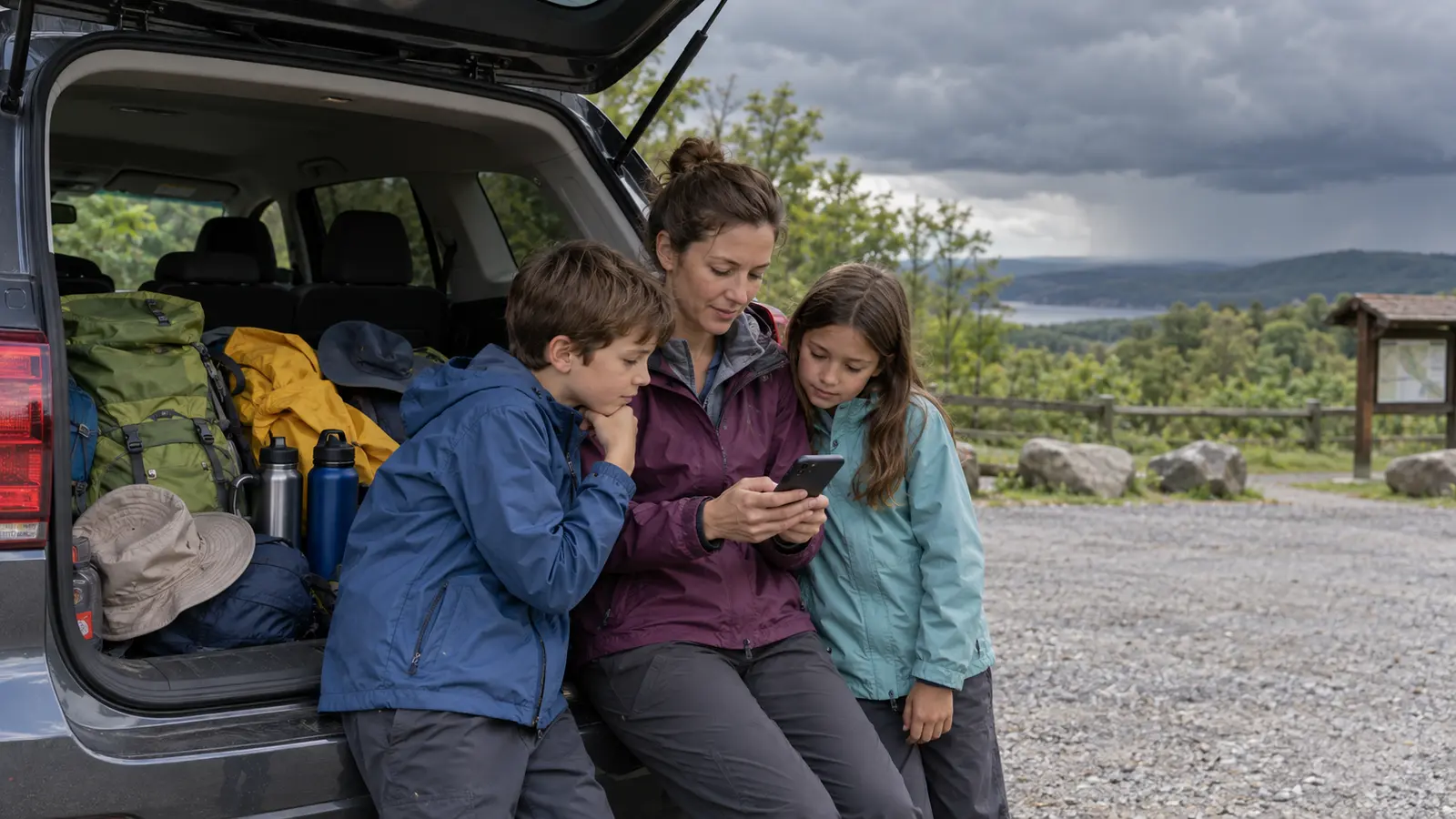
Look again at alerts, radar, hourly temperature, heat index when relevant, wind and AQI. Confirm the destination remains open and roads are usable. Compare conditions with the slowest family member and the retreat time. “We already packed” is not weather information.
State the outcome out loud: go, shorten or replace. For a shorten plan, name the turnaround time, closest substantial shelter and optional parts already removed. Put the backup address into navigation before leaving.
Check three: at the trailhead, beach or gate
Pause before paying, unloading or walking away from the car. Read posted notices, observe the sky and wind, and ask staff about local conditions when available. Confirm everyone has the right layers, water and energy. If reality is worse than the phone, reality wins.
The decision table without fake precision
Go
There is no relevant warning requiring action, the activity fits the forecast window, air quality works for every participant, facilities or shelter are available as planned and the family can exit well before conditions deteriorate. Go still includes a turnaround time and active monitoring.
Shorten
Conditions are manageable but the margin is thinner: heat or AQI calls for reduced intensity, showers make surfaces slower, wind removes an exposed segment, or storms are possible later. Choose a route with frequent exits, move the start earlier, delete the optional second act and keep the car or substantial building close.
Leave or replace
An official warning covers the activity or route; thunder is heard; flash flooding threatens low areas; heat alerts call for avoiding the planned exertion; AirNow guidance says the family's activity should move indoors; visibility or wind prevents safe supervision; a destination closes; or any participant develops concerning symptoms. Do not wait for everyone to agree that it feels bad.
Lightning: no tree, pavilion or poncho bargaining
The National Weather Service says lightning can occur any time of year. When thunder is audible, move to a substantial building or enclosed hard-topped vehicle and follow official local guidance. A picnic pavilion, dugout, tent, isolated tree or rain shell is not equivalent shelter.
On a gorge, beach or long trail, your shelter problem begins before the first thunder. Know how long the return takes and turn around early enough to reach a safe place. Never plan to “beat” a visible storm across exposed ground. Water activities and overlooks deserve a larger margin because retreat is slower.
Heat: use the alert and the child in front of you
NWS says an Extreme Heat Warning means take action and avoid outdoor activities, especially during the heat of the day. A Heat Advisory also calls for considering postponement or rescheduling. Alert criteria can vary by local office, so copying one city's number to every destination is false precision.
For a shortened warm-weather plan, begin early, reduce intensity, choose shade, schedule cooling breaks and carry adequate water. Never leave a child, disabled person or pet in a parked car. Stop activity and seek appropriate help for concerning signs such as confusion, fainting, severe weakness, vomiting or hot skin; do not use a web checklist to delay emergency care.
The family hydration guide can size the carrying system, while the sun-protection stack covers time, shade, clothing and sunscreen. Neither turns an extreme-heat warning into a hiking plan.
Air quality: check it like weather
AirNow identifies active children as a group that can be sensitive to air pollution. Its child guidance says orange, “Unhealthy for Sensitive Groups,” calls for limiting how long or hard sensitive and active people exercise outdoors. At red, active children and people with lung disease should avoid prolonged outdoor activity; purple and maroon require stronger limits.
Use the destination's current and forecast AQI, not the sky's color. Follow a child's asthma or other medical action plan and clinician advice. A cloth face covering is not a general substitute for rescheduling smoke exposure. If a child develops chest discomfort, trouble breathing or unusual fatigue, stop activity and seek appropriate care.
Rain, flood, wind and cold
Rain: evaluate traction, water level, visibility and temperature, not whether jackets exist. A wet paved loop can be reasonable while a gorge staircase is not. Flooding: obey closures and never drive or walk through floodwater. Water depth and road integrity are not visible promises. Wind: avoid trees, shoreline exposure and loose shelters when official alerts or observed branches make the area unsafe. Cold: protect dry layers and shorten the route before slow fingers and fatigue make simple tasks hard.
Destination staff can close facilities faster than a general weather feed updates. Official park, road and municipal notices belong in the check alongside the forecast.
The pack supports the decision
- Water and food sized for the plan plus a modest delay, with allergy or medical needs handled separately.
- Activity-appropriate rain and insulation layers in reachable locations.
- Sun protection and any clinician-directed medication.
- A charged phone, offline map or saved route, and backup power when the day's consequences justify it.
- A small dry bag for electronics and one dry layer.
- The address of substantial shelter or the indoor replacement.
- A towel, spare socks and cleanup bag left in the car.
Food and restrooms are part of weather resilience. Use the restroom before leaving a developed area, eat before fatigue compounds cold or heat and do not count on a seasonal concession. The family power guide helps keep the forecast and navigation available without treating a battery as emergency expertise.
The child and meltdown layer
Tell children the plan may change because the family's job is to come home well. Give the backup a real identity—library, museum, lunch stop, hotel pool—not “nothing.” If disappointment is rising, feed first, lower the number of choices and move to the replacement. Never make a child prove toughness against weather.
Forecast improves: do not restore every deleted objective; keep the shorter plan. Light rain starts: use the prepared layer and the preselected turnaround, not endless renegotiation. One child feels wrong: stop, assess and leave early. Adults disagree: the more conservative safe plan wins.
Cost and booking guidance
The framework itself costs nothing. Its financial rule is to know the weather policy before buying. For nonrefundable tickets, decide whether the family would still use the indoor or shortened version. Do not let sunk cost override an active warning, closure or child's health. Travel insurance can have definitions, exclusions and documentation rules; read the actual policy rather than assuming “weather” is covered.
Who should skip the outdoor version
Skip or replace it when a participant's medical plan conflicts with conditions, the route has no realistic shelter or exit, the only adult is not comfortable managing all children in the forecast, required gear is missing, official alerts call for action incompatible with the activity, or the backup depends on conditions magically improving. The day can still count indoors.
Authoritative check-before-you-go sources
Guidance was checked September 5, 2026; alerts and forecasts are live products and must be rechecked for the exact destination.
- NOAA/National Weather Service: lightning safety
- NOAA/National Weather Service: heat watches, advisories and warnings
- NOAA/National Weather Service: heat safety for children
- U.S. EPA AirNow: child activity guidance by AQI category
- U.S. EPA AirNow: outdoor activity guidance for children
MAKE THE WEEKEND COUNT
Useful beats heroic.
Build the day your family can finish well, then leave enough energy for the ride home.
More family plans