DAD SYSTEM · CROWDED PLACES
The Family Lost-Kid Plan: What Children Should Do Before You Get Separated
The plan is not “never get separated.” The plan is a short script every child can use, a response every adult follows, and one practice round before the crowd gets loud.
This is a systems problem, not a scary speech
Children separate in ordinary ways: one stops at an exhibit, a crowd closes around a family, two adults each assume the other has the child, or a bathroom exit has two directions. A useful plan deals with those boring failures. It does not make a child responsible for preventing every danger, and it does not teach that every unfamiliar adult is automatically unsafe.
NCMEC's KidSmartz material emphasizes practicing responses, identifying places to go for help and telling a trusted adult when something feels wrong. The adult job remains primary. The child gets a few clear actions; the grown-ups get the search and escalation system.
The five-minute arrival drill
- Photograph what everyone is wearing. One current full-body photo per child is useful if staff ask for clothing and appearance. Delete it later if you do not want it retained.
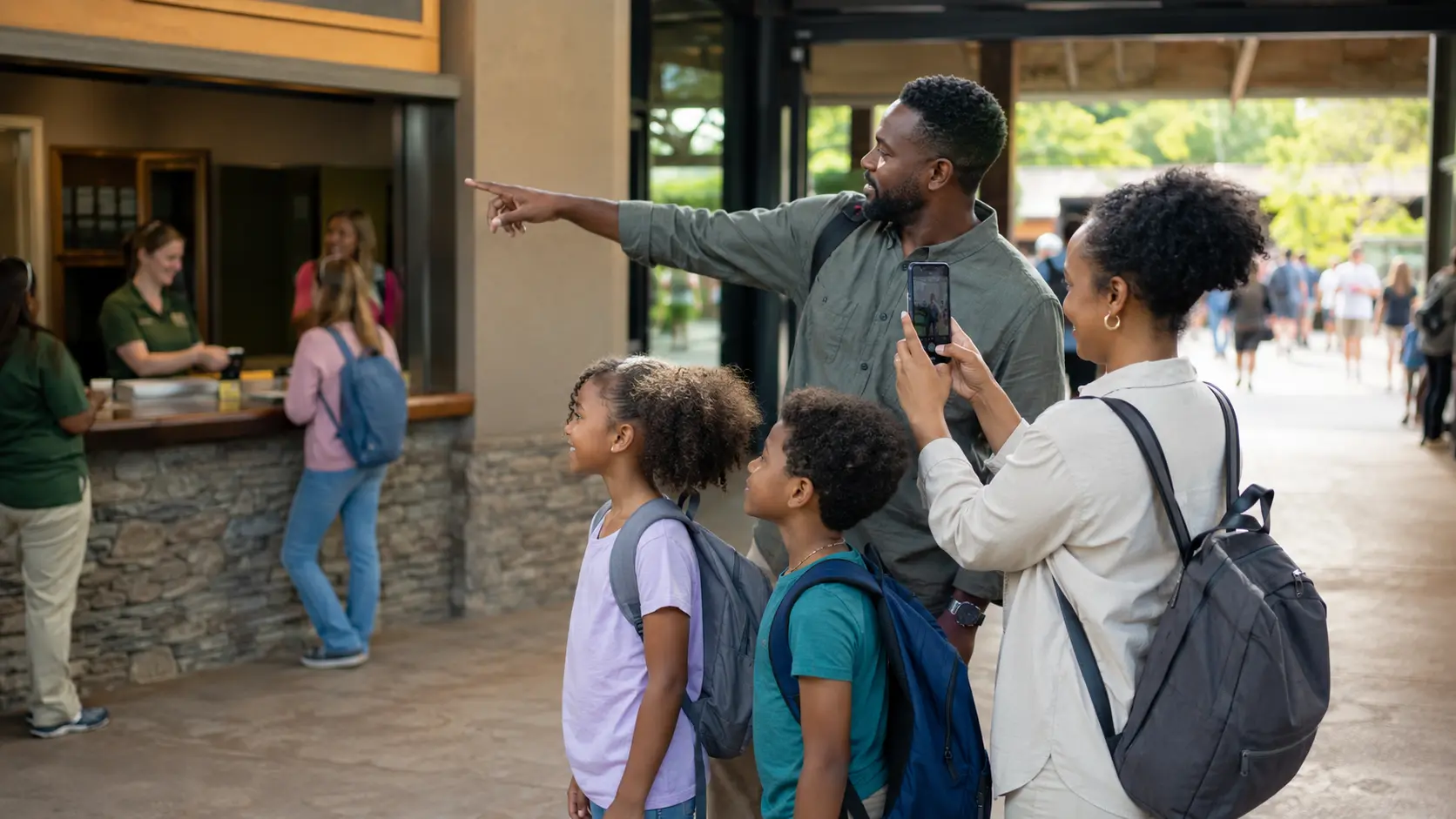
- Point out the help people. Use the venue's actual staff: guest services, ticket counter, uniformed employee, ranger, librarian or museum worker. A parent or caregiver with children is a practical second option when no employee is visible.
- Pick one visible place. For children old enough to navigate independently, choose a staffed, unmistakable meeting point. Do not choose a moving parade, generic bench or “the front.”
- Practice the phone number. The child should know a caregiver's first and last name plus one mobile number. A card in a secure pocket is backup, not a substitute for practice.
- Say the boundary. No child leaves the venue, parking area or agreed zone with anyone unless reunited with the responsible adult or directed through the venue's verified emergency process.
Run this before phones, tickets and snacks consume attention. The amusement-park plan uses the same principle: solve the handoff before the line gets loud.
The child's script: stop, help, tell
Stop moving
For most separations inside a bounded public place, the child should stop near the last safe place they remember instead of wandering through the venue looking for adults. Move out of immediate hazards—traffic, water, ride gates, escalators—but do not start a building-wide search. A stationary child is easier for staff and family to locate.
Find visible help
Approach a uniformed employee, staffed counter, ranger, cashier or other clearly identified venue worker. If none is visible, ask a parent or caregiver who is with children to contact staff. The child can say: “I cannot find my family. Please stay here with me and call guest services.” They do not need to tell a crowd every personal detail.
Tell the useful facts
Give the adult the caregiver's full name, mobile number and the last place the family was together. If the child cannot remember the number, the card or wrist note helps. Children should know that they will not be punished for getting separated. Fear of getting yelled at makes a simple problem harder.
The adult response: report first, search second
The moment separation is confirmed, tell venue staff or security and follow their established protocol. Many businesses and public places use a coordinated missing-child response such as Code Adam. Give the current photo, name, age, clothing, identifying details, last known location and any medical, communication or mobility need.
When two responsible adults are present, one should stay at the last known location or agreed meeting point while the other reports to staff, unless staff direct otherwise. Do not have both adults roam independently with dead phones and no rendezvous. Keep the contact line available. Check immediate hazards and bathrooms with staff guidance, and do not broadcast sensitive information beyond people assisting the search.
If the child may have left the site, is near traffic or water, has urgent medical needs, may be with an unsafe person, or the circumstances suggest danger, call 911 immediately. Do not wait for an arbitrary number of minutes. For an ongoing missing-child case, law enforcement can coordinate with the National Center for Missing & Exploited Children at 1-800-THE-LOST. NCMEC is not a replacement for calling 911 in an emergency.
Age and ability change the plan
Younger or impulsive children: the adult prevention system does most of the work—direct hand contact, stroller or carrier where appropriate, bright clothing, one named supervisor and no ambiguous handoffs. The child script may be only: stop, find a worker, say the caregiver's name.
School-age children: practice the full script and one phone number. Let them identify the real employee at arrival. Older children with phones: set a text/call sequence, location-sharing boundaries and a battery floor. A phone can fail; retain the physical meeting point. Children with communication, sensory or developmental needs: use a card, AAC message, medical identification or venue accessibility support that matches the child. Tell staff the best way to approach and communicate.
Tools that can help—and what they cannot do
A contact card, writable wristband, phone, watch or location device can reduce friction. None replaces supervision, a practiced response or immediate staff involvement. Trackers can lose power, connection or location accuracy; they also create privacy and account-security questions. If you already own one and use it lawfully, test it before the trip and decide who can access the data.
No purchase is required. A folded card in a zipped pocket and a marker-written number can do the basic job. Avoid displaying a child's full name where a stranger can read it casually. Put the adult contact information where a helper can find it after the child asks for help.
Prevent the adult handoff failure
Most family systems break at transitions. Say the handoff out loud: “I have Sam while you buy tickets.” The receiving adult answers: “I have Sam.” Do it at bathrooms, food lines, rides, hotel lobbies, train platforms and car loading. “I thought you had them” is not a child-behavior problem.
Use a quick head count at every threshold. The day-trip system builds those checkpoints into arrival and departure. The hotel-room system does the same around elevators, pools and morning exits, while the radio guide explains why radios are coordination tools, not supervision substitutes.
Practice without scaring anybody
Use a two-minute role-play in a calm place. Parent walks ten steps away while remaining visible. Child practices stopping, identifying a staff role and saying the contact sentence. Switch locations and repeat once. Praise the actions, not fear. Do not stage a surprise disappearance to “teach a lesson.” That tests panic, not the plan.
After the outing, ask one question: “If we got separated here, who would you ask?” If the answer is specific, the system is working. Update the plan when the destination changes. A state park, subway station, festival and hotel need different help points.
Who should use a tighter plan
Use direct one-adult/one-child responsibility when the site has open water, traffic, transit platforms, dense nighttime crowds, multiple exits or unreliable cell service. Also tighten the plan when a child bolts, freezes, cannot communicate contact details or is unfamiliar with public helpers. Contact the venue's accessibility or guest-services team before arrival when specialized assistance matters.
Authoritative safety resources
Resources were checked September 1, 2026. Venue procedures and emergency conditions vary.
- National Center for Missing & Exploited Children: prevention education
- NCMEC KidSmartz: personal-safety practice for grades K–5
- NCMEC Code Adam: coordinated missing-child response
- National 911 Program: calling 911
MAKE THE WEEKEND COUNT
Useful beats heroic.
Build the day your family can finish well, then leave enough energy for the ride home.
More family plans