GEAR SYSTEM · HAUL LESS BADLY
Family Folding Wagons: Pull Wagon vs Utility Cart—and When to Carry It
A wagon can save the adult’s shoulders or become a wide, rolling argument. Decide whether it carries children, cargo, or nothing before comparing wheel size.
Start with the passenger question
“Folding wagon” describes a shape, not one safety category. Some products are sold only to move cargo. Others are designed and labeled for children and may fall under stroller requirements. Features that look family-friendly—shade, padded sides or cup holders—do not substitute for the manufacturer's stated intended use, age limits, restraints and instructions.
The distinction is not theoretical. In October 2025, the U.S. Consumer Product Safety Commission recalled Pack-N-Stroll Premium Folding Utility Wagons because a gap could entrap a child's head and the product lacked a restraint system, violating the mandatory stroller standard. The lesson is not that all wagons are dangerous. It is that a retail category name and a photograph of children do not establish safe passenger use.
If children will ride, require a current manual that explicitly permits it, all required restraints, an appropriate age and fit, and a clean recall search. If any of those are missing, treat the wagon as cargo-only.
The three useful options
Pull wagon: familiar steering, poor on descents
A traditional pull handle gives the adult a clear line of sight to the route ahead but puts the wagon behind the adult. It can track well on a flat path and cut corners badly when crowded. On a slope, the adult may be trying to restrain weight that is pulling downhill. A parking brake helps only when stopped; it is not a universal downhill-control system.
Choose this format for mostly flat, wide routes when the loaded pull feels controlled. Skip it for steep hills, dense crowds or any route where the adult needs to watch cargo continuously.
Push-pull child wagon: only when the manual says so
A purpose-built child wagon can provide a push position, restraints and passenger guidance. It also becomes stroller-like equipment with more parts, more folded bulk and a higher need to follow the exact manual. Compare the approved number and size of occupants, seating and harness instructions, brake operation, canopy clearance, entry/exit method and whether bags affect stability.
Do not hang extra bags from a handle unless the manufacturer permits it. Do not let children stand, climb the side, ride unrestrained or enter while the wagon can roll. Never park it on a slope and trust the brake as supervision.
Cargo utility cart: honest and simple
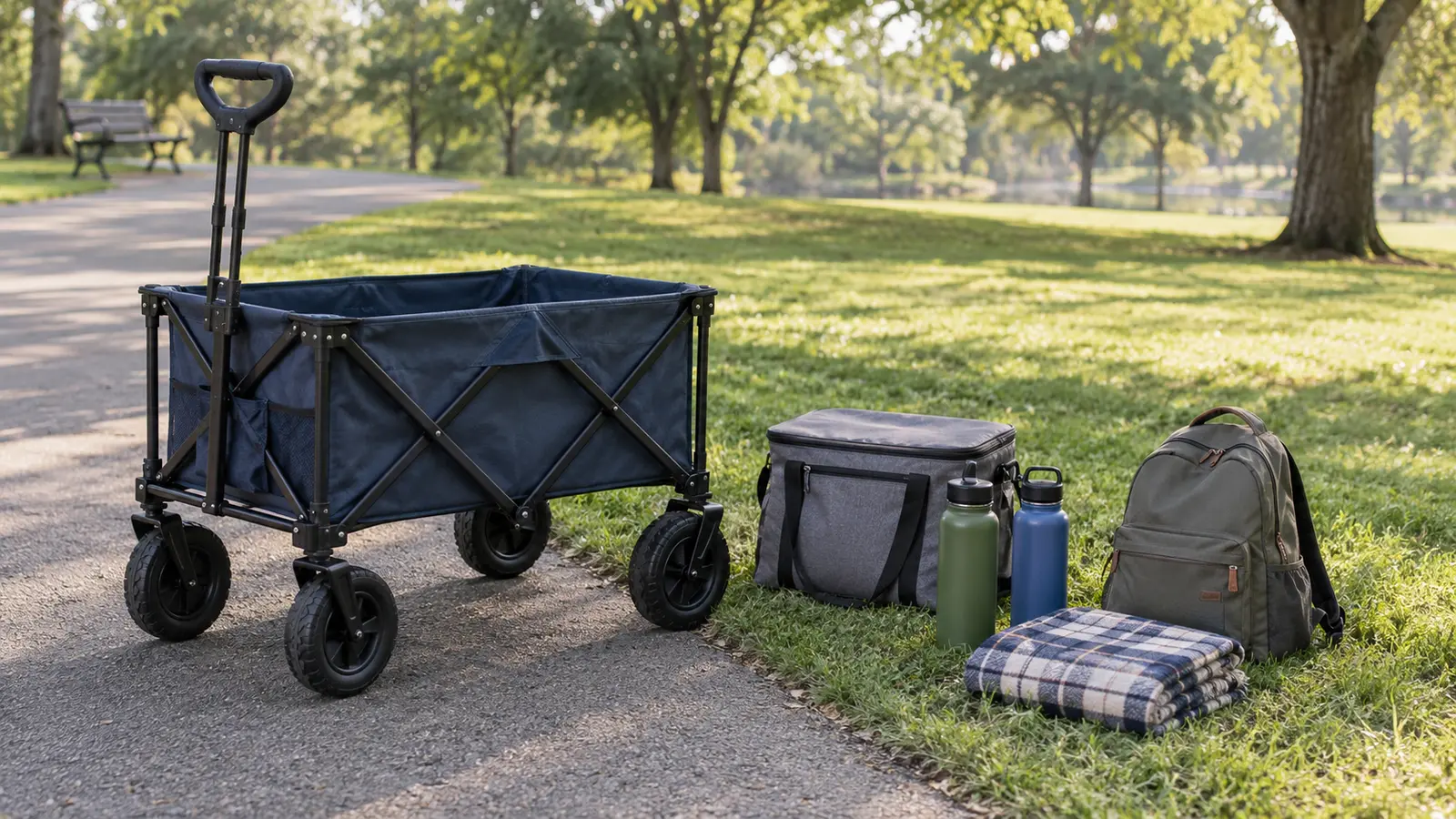
A cargo-only folding cart can move a cooler, chairs and layers between the car and a fixed picnic base. It usually costs less than a passenger wagon and avoids pretending gear and people need the same design. The limit is simple: no riders.
This is the best fit when school-age children walk reliably and the problem is bulky equipment. It is the wrong answer when the family will move every twenty minutes, climb stairs or encounter a narrow trail.
Run the no-buy route test
- Put the real cooler, water, seats and layers on the floor.
- Remove anything without a defined job. Use the day-trip packing system.
- Measure the remaining load and the smallest vehicle opening it must pass through.
- Map steps, curbs, gravel, soft grass, narrow gates and the longest uninterrupted carry.
- Check the exact destination's wagon and stroller policy.
- Borrow a suitable wagon or simulate the load in a rolling suitcase for one outing.
If one adult can carry the smaller load while keeping a hand free, the wagon may not solve enough. If the route has stairs or a shuttle, it may create a new lifting problem. The best no-buy choice is often one soft cooler, one shared blanket and each child carrying a small water bottle.
Compatibility checks that matter
- Folded dimensions: measure the trunk with the actual seats and luggage in place. Do not use cargo volume alone.
- Loaded mass: add the real contents. A high stated capacity can still be miserable to start, stop and lift.
- Wheel and ground match: small hard wheels suit smooth pavement better than sand, deep gravel or roots. “All terrain” is marketing unless the maker defines conditions.
- Steering and turning space: test a full turn without jackknifing or clipping ankles.
- Brake: identify what wheels it holds and how it is verified before loading. Follow the manual.
- Handle fit: the main adult should be able to push or pull without stooping or striking the frame.
- Fabric and frame care: read cleaning, drying, storage and corrosion guidance.
- Recall status: search CPSC by exact brand and model, including secondhand gear.
Venue rules can end the comparison
Zoos, museums, stadiums, fairs and amusement parks may distinguish strollers from wagons, ban certain dimensions, or restrict equipment during crowded events. Open the policy for the exact venue and date. A product listing that says “festival wagon” cannot override a gate rule.
For a zoo, compare the wagon with the two-loop zoo plan: if the family can use an indoor reset and leave after two loops, less cargo may win. For a picnic, pair the wagon decision with the seating guide so four chairs do not create the need for a cart.
What not to buy
- A cargo wagon for child passengers because an online photo shows a child inside.
- A used wagon without its label, manual, restraints or model identification.
- A model whose folded size was never measured against the vehicle.
- A wide wheelbase for narrow museum aisles or crowded event paths.
- An unverified “all-terrain” claim for sand, hills or rough trails.
- A higher capacity merely to carry more optional equipment.
- An attachment, handle bag or seat insert the manufacturer does not approve.
Setup and operating rules
Open and lock the frame exactly as instructed, with fingers clear of hinges. Check fabric, fasteners, wheels, handle and brake before loading. Put dense cargo low and centered. Keep straps and loose items away from wheels. No one rides in a cargo-only cart. In a child-approved model, use the specified seating and restraints every time.
Stop before curbs and transitions. Do not drag a loaded wagon down stairs. Keep it away from traffic, platforms, water edges, fires and slopes. At the car, unload children first into a controlled position with an adult, then deal with gear. The family parking-lot plan turns that transfer into a sequence.
Who should skip it
Skip a wagon for destinations dominated by stairs, shuttles, narrow doors or frequent moves. Skip passenger wagons when a child will not remain seated and restrained as required. Skip cargo wagons when an adult cannot control the loaded weight on the full route. Skip the purchase when carrying less solves the same job.
Official safety sources
MAKE THE WEEKEND COUNT
Useful beats heroic.
Build the day your family can finish well, then leave enough energy for the ride home.
More family plansTHE USEFUL STUFF
Gear that removes friction.
These are practical categories to compare—not a reason to overpack. Check fit, specifications and current reviews before buying.
Paid links: As an Amazon Associate I earn from qualifying purchases. You pay no additional cost.
Cargo-only folding utility wagons
Confirm the maker permits the intended load, then compare folded size, loaded control, wheel type and the destination rule.
See current options → COMPARE ON AMAZONChild-approved folding wagons
Require explicit passenger approval, current age and fit guidance, required restraints, brake instructions and a clean recall check.
See current options → COMPARE ON AMAZONFolding utility carts with larger wheels
Match wheels to the real surface and measure the folded cart against the loaded vehicle before buying.
See current options →