GEAR SYSTEM · LOUD EVENTS
Family Hearing Protection: Earmuffs vs Earplugs—and Why NRR Is Not a Fit Test
The protector that seals, stays on and appears before the noise starts beats a bigger number in the bottom of the bag. Buy for the person, then rehearse the fit.
Start with the hazard, not the product
The National Institute on Deafness and Other Communication Disorders says long or repeated exposure at or above 85 dBA can cause hearing loss, and louder sound shortens the time it takes. It lists sporting events and concerts around 94–110 dBA and fireworks shows around 140–160 dBA. Those are broad examples, not measurements of your seat.
Distance and duration matter. The first controls are to choose a quieter location, increase distance from speakers or engines, take breaks in a genuinely quieter area and leave when the environment cannot be made reasonable. Hearing protection is the last layer, not permission to keep a child beside a speaker or fireworks launcher.
This is a purchasing and logistics guide, not a diagnosis or a personalized exposure calculation. A child with ear pain, tubes, a hearing condition, sensory needs or difficulty inserting plugs should have product choices discussed with an audiologist or clinician who knows the child.
The quick decision
- Young or first-time user: start with properly sized passive earmuffs that fully surround the ears.
- Hot, long event and capable user: pre-molded or foam earplugs may be more comfortable, but insertion and fit are the whole job.
- Music quality matters: consider labeled flat-attenuation or musician-style earplugs after confirming size, fit and actual NRR.
- Intermittent noise: earmuffs or pre-molded plugs are easier to remove and replace than foam plugs that require clean hands and reinsertion.
- Very loud or impulse environment: do not improvise from this guide. Increase distance, leave and use professional or venue safety guidance; occupational double-protection rules are not a do-it-yourself formula for children.
Earmuffs: easiest to see, not automatically sealed
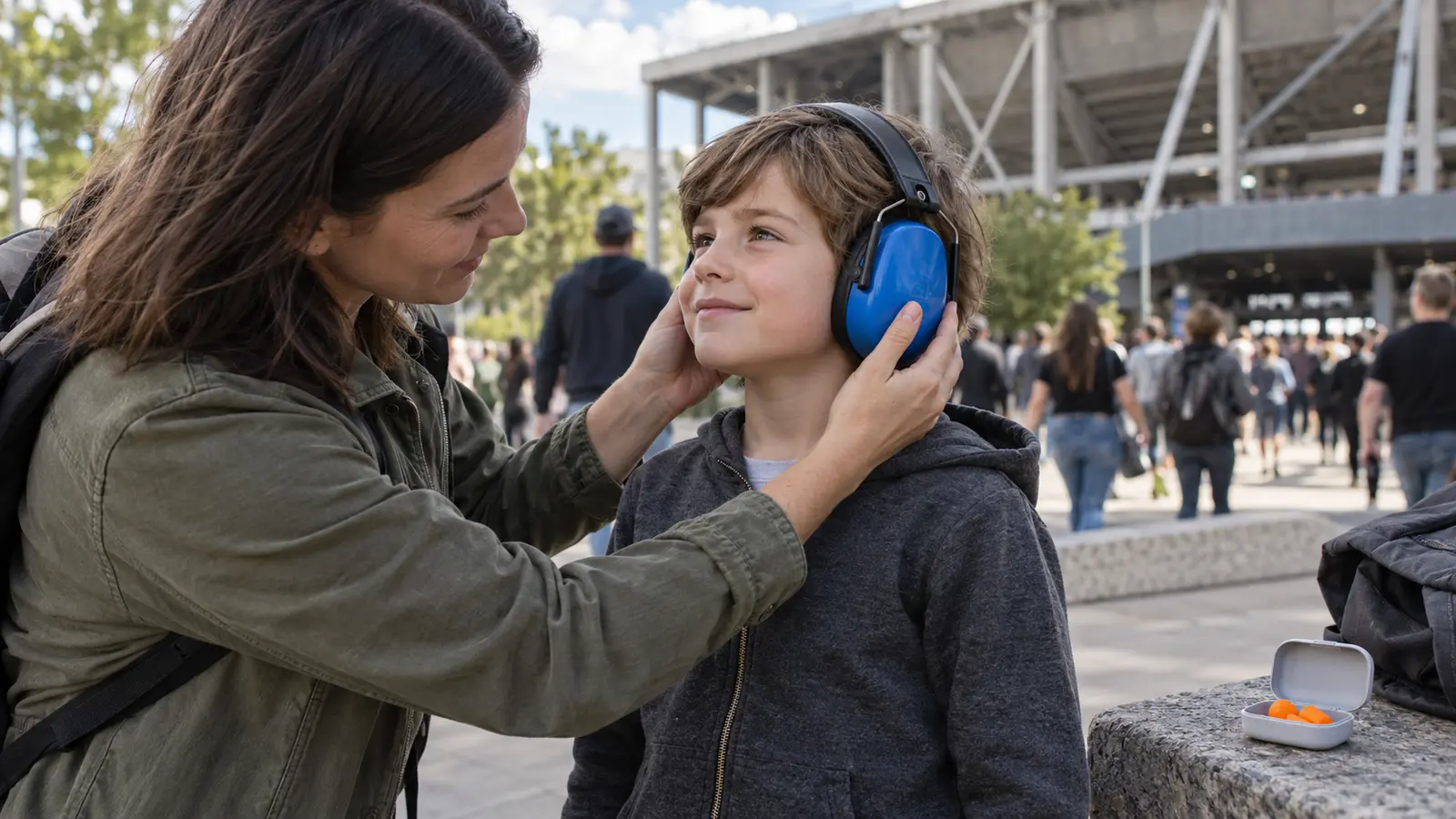
Passive hearing-protection earmuffs surround the outer ear with cushioned cups held by a headband. An adult can see whether they are on, and a child can remove and replace them without touching the ear canal. That makes them practical for stadiums, parades, concerts, motorsports and fireworks viewed from a conservative distance.
Fit fails when the cups are too large, the headband has too little pressure, hair bunches beneath the cushion, hat brims interfere or eyeglass temples create a gap. The entire ear needs to sit inside the cup. Slide hair away, center both cups and run a finger around the seal. Have the child speak and listen; the change should be obvious but not painful.
Tradeoffs are real. Muffs are bulky, warm and can interfere with hats, glasses, bike helmets or other safety equipment. NIOSH notes that earmuffs may be uncomfortable in warm places and their cushions may not seal effectively in very cold conditions. Do not force a helmet over a headband or compromise another required piece of safety gear.
Earplugs: compact, but technique-dependent
Foam plugs compress, insert and expand in the ear canal. Pre-molded plugs arrive shaped and may be faster to reuse. Custom plugs require a professional impression. Earplugs store easily and can be comfortable for a long hot event, but NIOSH says they may be harder to fit correctly. A plug resting near the canal is not the same as a fitted plug.
Follow the manufacturer's insertion instructions exactly. Use clean hands. Do not cut, improvise or push a plug painfully deep. A child must be mature enough to report discomfort, leave the plug alone and avoid losing it. Small plugs can be a choking hazard around younger children; store and dispose of them securely.
For reusable plugs, follow cleaning and replacement directions. Replace damaged, hardened or dirty pieces. Foam plugs are often designed for limited use; the package instructions outrank a general routine. Never share inserted earplugs between people.
What the NRR does—and does not—tell you
Hearing-protector packaging in the United States commonly carries a Noise Reduction Rating. It is a laboratory label, not a promise of the reduction a particular child will receive in a particular seat. NIOSH says the manufacturer's NRR often does not reflect the actual protection received by each worker and identifies individual fit testing as the best check.
Do not subtract the box number directly from a phone sound-meter reading and declare the child safe. Consumer phone microphones are not a substitute for calibrated measurement, venue exposure varies, and individual fit changes performance. Use NRR to screen legitimate labeled protectors within the same use case, then prioritize correct size, seal, comfort and continuous wear.
NIOSH also warns against overprotection in work settings because too much reduction can limit situational awareness and cause people to remove the protector. For families, that means adults must preserve communication, sight lines and the exit plan. Hearing protection never replaces direct supervision.
ANC headphones are a different tool
Active noise cancellation uses electronics to reduce some incoming sound, particularly steady low-frequency noise. NIOSH says noise-canceling headphones or earbuds should not be considered hearing protection unless labeled with an NRR. A familiar audio headset can make travel feel calmer without being certified protection for a concert, fireworks or machinery.
Do not play louder music inside the protector to cover the outside sound. The goal is lower exposure, not competing sound sources. If communication headphones or electronic level-dependent protectors are being considered, verify the exact labeling, battery behavior and manufacturer instructions.
The no-buy fit test
- Borrow or use an existing correctly labeled protector that is hygienic and appropriate for the wearer.
- Try it at home for ten minutes without media playing. Check pressure, heat, glasses, hair and speech.
- Have the child remove and replace it while an adult watches.
- Practice the family signal for “too loud,” “need a break” and “leave now.”
- Pack it in the exact bag and confirm it remains reachable before the venue line.
If the child will not wear the protector at home, buying a more expensive version at the gate will not create a plan. Change location, shorten the event or skip it.
What to compare before buying
- A real NRR label for use as hearing protection, not a vague “noise reducing” claim.
- Headband adjustment and cup dimensions that fit the actual child or adult.
- Cushion condition, replacement availability and a seal that works with required glasses.
- For plugs, size range, insertion method, cleaning rules and choking-hazard considerations.
- Comfort for the expected duration and climate.
- A plain case that keeps protectors clean and immediately reachable.
- Return terms before opening hygiene-sealed products; earplug returns may be restricted.
Do not buy unlabeled novelty earmuffs, audio headphones marketed with an unexplained decibel claim, or one oversized pair expected to fit every head. A gigantic NRR number does not repair a bad seal. The family binocular guide uses the same rule: fit beats the headline specification.
Event logistics: put it on before the noise
Set up in the parking area or a quiet lobby, not after the first blast. Keep each person's protector in the reachable layer of the family daypack. Carry a labeled spare only if someone can actually use it. For foam plugs, add clean hands or sanitizer and follow the package directions after hands are dry.
Choose seats and routes with distance and exits in mind. At food or restroom breaks, move to a quieter zone before removing protection. Recheck fit when glasses, hats or wet hair change. In rain, keep plugs dry and protect earmuff cushions; in heat, schedule quiet cooling breaks rather than accepting a sweaty broken seal.
The adult must still be able to communicate a stop signal and account for every child. Pair this guide with the lost-kid protocol at crowded venues and the amusement-park plan for line and exit discipline.
When to leave and when to get help
Leave if a child reports pain, ringing, muffled hearing, dizziness or distress; do not bargain for one more song or lap. NIDCD notes that temporary changes after loud noise can fade while residual long-term damage may remain. Seek medical advice for sudden hearing changes, persistent ringing, pain, drainage or any concern about injury. Emergency symptoms need emergency care.
Cost, packing and the no-shill answer
Basic passive muffs and plugs span a wide price range, but price does not prove fit. The honest first purchase is one labeled protector for the actual wearer plus a clean case—not a matching family set. If an event is rare, borrowing a hygienic, properly fitting pair can be smarter. Venue concessions may sell hearing protection, but do not rely on stock, child sizes or current prices.
Who should skip the event: a child who cannot tolerate or reliably wear adequate protection, anyone with unresolved ear symptoms, or a family whose only plan is to stand close and “see how it goes.” Distance, time and leaving remain valid protection.
Authoritative sources
Safety and product-selection guidance was checked September 5, 2026.
- NIH/NIDCD: noise-induced hearing loss, exposure and prevention
- CDC/NIOSH: hearing-protector types, fit, NRR limits and compatibility
- U.S. EPA: noise pollution and personal protection
MAKE THE WEEKEND COUNT
Useful beats heroic.
Build the day your family can finish well, then leave enough energy for the ride home.
More family plansTHE USEFUL STUFF
Gear that removes friction.
These are practical categories to compare—not a reason to overpack. Check fit, specifications and current reviews before buying.
Paid links: As an Amazon Associate I earn from qualifying purchases. You pay no additional cost.
Youth hearing-protection earmuffs
Compare the labeled NRR, cup dimensions, headband adjustment and seal on the actual child.
See current options → COMPARE ON AMAZONLabeled reusable earplugs
Check the size range, insertion method, cleaning instructions and real NRR rather than a vague noise-reducing claim.
See current options → COMPARE ON AMAZONLabeled foam earplugs
Choose clean, individually stored plugs only for users who can insert and wear them correctly.
See current options →