1 · point first
With binoculars down, point at one high-contrast stationary target and name what sits beside it.
GEAR SYSTEM · BINOCULARS
For most family nature days, 8x is the sane default. A child who can find the bird, hold the view steady and focus quickly will see more than a child fighting impressive specifications.
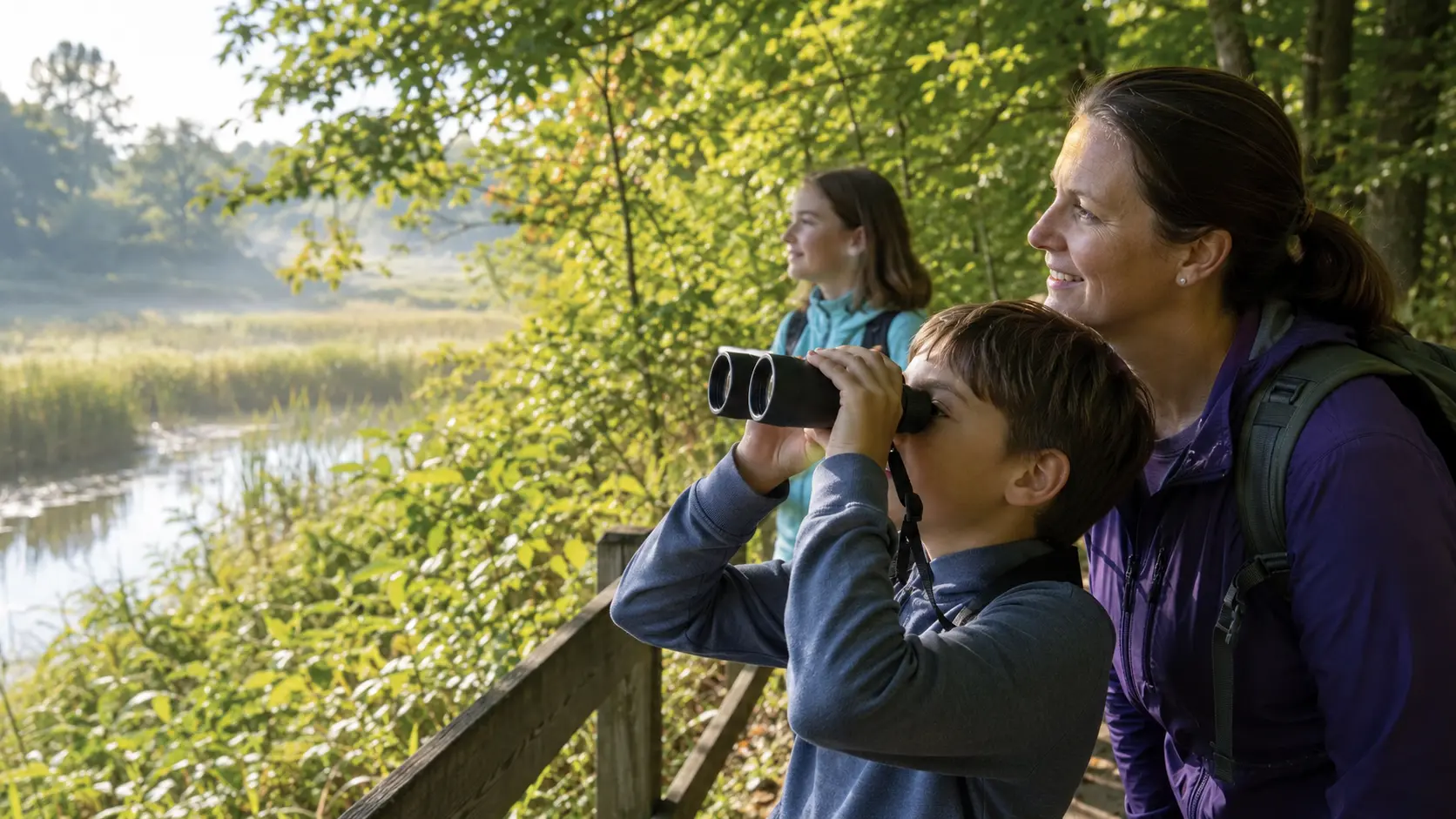
First: who will carry it? An adult-shared pair can be a full-size 8x42. A child-controlled pair may need a lighter 8x25 or 8x32 body, but compact binoculars can have tighter controls and smaller exit pupils. Second: what are you watching? Birds in brush reward a wide field; distant, mostly stationary subjects may justify 10x. Third: can the user merge the two circles into one clear image? If the hinge will not close enough for the child's interpupillary distance, the rest of the specifications do not matter.
This is gear for the Beaver Lake short-trail plan, the first-hike system and quiet lake overlooks. It is not a reason to load another heavy object into every outing.
An 8x binocular makes a subject appear eight times closer than the unaided view. Cornell Lab explains that higher magnification generally reduces field of view and notes that this is one reason many birders prefer 8x. A wider field leaves more room for error when a beginner raises the binocular and helps keep a moving subject inside the view.
Eight-power models are also easier to hold steady. That is not a claim that every 8x is lighter or better; construction, lens size and ergonomics vary. It means the magnification itself asks less of shaky hands. For a school-age child learning to aim, focus and follow, that usually beats extra reach.
Ten-power can help with distant shorebirds, open-country wildlife or a mostly stationary subject when the user has steady hands. It also narrows the field, amplifies movement and can make the first acquisition harder. A child who repeatedly sees blackouts, loses the bird or hands the binoculars back after 30 seconds is not under-equipped; the binocular is poorly matched.
Do not compare 8x and 10x in isolation. Compare the maker's stated field of view, weight, eye relief, close-focus distance, waterproofing claim and minimum interpupillary distance for the exact model.
In 8x42, the 42 is the objective-lens diameter in millimeters. Larger objectives can gather more light, but they also tend to increase size and weight. A full-size 8x42 is an excellent adult all-rounder. An 8x32 can be a strong family compromise. An 8x25 is easier to carry but may be fussier in dim light and less forgiving of eye position.
There is no universal “kids need 21mm” rule. The body must fit the child's hands and eye spacing. The image must merge. The focus wheel must turn without the child shifting grip. Test those things before buying by reputation.
Never use binoculars to look at the sun. Teach the rule before the first handoff, supervise children, and keep optics put away during running, climbing and road crossings.
Field of view is the width visible at a stated distance, often feet at 1,000 yards or degrees. Wider is usually friendlier for beginners. Eye relief is the distance behind the eyepiece where the full field can be seen; eyeglass wearers often need more. Close focus is the nearest distance at which the binocular can focus, useful for butterflies, insects and nearby birds.
Those are not quality scores. A wide field with poor edge control, a generous eye-relief number with awkward eyecups or a close-focus claim with a stiff wheel can still fail a family. Read the exact manual and current manufacturer specification, then test.
8x42: best when an adult carries and shares one bright, comfortable pair. 8x32: the strongest general family compromise when fit and budget work. 8x25: best when low weight is what gets the binocular outside, with tradeoffs in low-light comfort and handling. 10x42: for a steady, experienced viewer who genuinely needs distance. Zoom binoculars: usually add complexity and a narrower field; they are not the easy answer for kids.
Borrow one pair and run the target test. Many nature centers, libraries, birding clubs and relatives can provide a first experience. Share an adult pair by using the neck strap and resetting the hinge. If the child prefers unaided observation, a simple bird guide, or taking a phone photo of a distant shape for later identification, believe them. Interest is the scarce resource.
The daypack guide helps decide whether the binocular earns space. If it comes, carry it on a proper strap or harness, keep the lens caps managed, and clean only according to the maker's instructions. The rain guide is a reminder that weather resistance is not permission to leave optics soaked in a pack.
Set a use case, not a price ceiling disguised as research. For a first shared pair, compare 8x32 and 8x42 models with wide fields and useful eye relief. For a child-owned pair, compare low weight, minimum eye spacing and focus-wheel access before optical prestige. Buy from a seller with a real return window, verify warranty terms at purchase, and inspect the exact package for strap and lens protection.
Three categories are worth comparing below: a family-friendly 8x32, an adult-shared 8x42 and a compact 8x25. Those are category links, not claims that every result is appropriate. Confirm dimensions, weight, eye relief, field of view, close focus and warranty on the manufacturer's current page.
Technical references were checked September 1, 2026. Product specifications change by model and revision.
MAKE THE WEEKEND COUNT
Build the day your family can finish well, then leave enough energy for the ride home.
More family plansTHE USEFUL STUFF
These are practical categories to compare—not a reason to overpack. Check fit, specifications and current reviews before buying.
Paid links: As an Amazon Associate I earn from qualifying purchases. You pay no additional cost.
Compare minimum eye spacing, field of view, eye relief, weight and the maker's exact waterproofing claim.
See current options → COMPARE ON AMAZONA brighter full-size option when an adult carries it; verify the child's grip and merged view before keeping it.
See current options → COMPARE ON AMAZONChoose low weight only after checking focus-wheel access, eye spacing, field of view and return terms.
See current options →