GEAR SYSTEM · ROAD TRIPS
Family Travel Games: Cards vs Magnetic Games vs a Tablet—and the No-Buy Kit
The best travel game is not the cleverest box. It is the one your kids can start, pause and clean up in the space you actually have—without making a carsick child stare down.
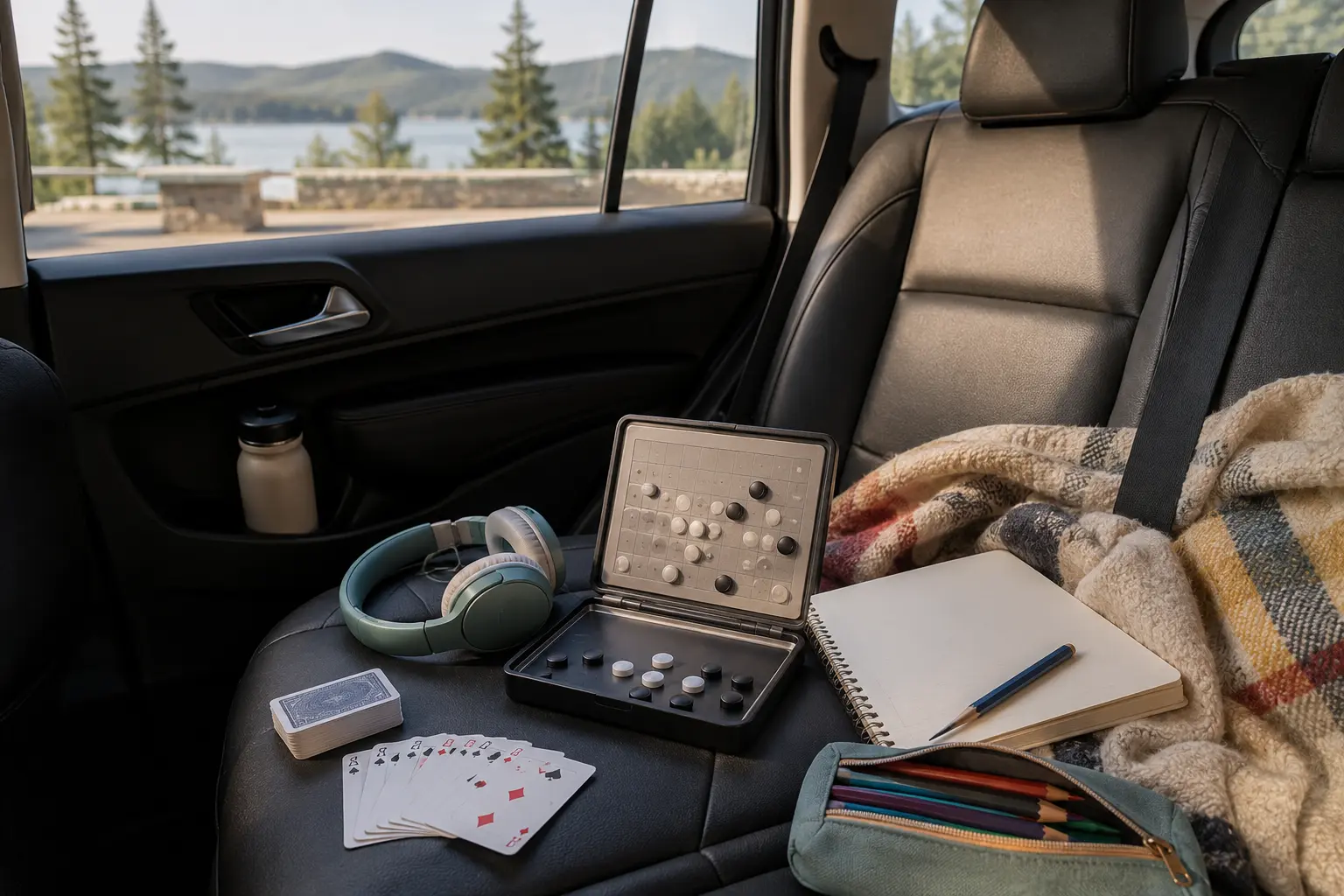
Choose for the trip, not the toy aisle
A two-hour drive, a train table, a restaurant wait and a rainy hotel evening are four different game environments. Start with the constraints: how much flat space exists, who must hold the pieces, how quickly play must stop, whether noise matters, and who becomes nauseated while looking down.
This guide is for school-age children who can follow simple rules and handle small components with supervision. Younger siblings change the risk calculation. If a piece can become a choking hazard, disappear into a seat rail or start a fight when lost, it belongs in the hotel room—not loose in transit.
The quick answer
- Car: spoken games and audio first; cards or drawing only at stops or for riders who know they tolerate visual tasks.
- Train: magnetic boards, cards with a compact tray and pencils work well because there is usually a table and less abrupt motion.
- Plane: prioritize quiet, contained and pauseable activities. Avoid anything that can roll several rows.
- Hotel: a normal deck, small board game or printable challenge can use the room table; piece containment matters less.
- Restaurant or line: use a pocket deck, conversation game or no-equipment challenge that clears instantly.
Cards: maximum play per ounce
A standard deck can run matching games, memory, Go Fish, War, simple solitaire, cooperative sorting and made-up challenges. It is cheap to replace, familiar across ages and genuinely useful after arrival. Cards are weakest in wind, on narrow laps and anywhere a dropped card vanishes under fixed seating.
Choose washable or durable cards only if that feature matters to your family. Oversized cards can help small hands but consume table space. Specialty travel decks are worthwhile when the rules are excellent and the whole family understands them; a shelf of clever boxes is not a travel system.
Magnetic games: contained, not magically unlosable
Magnetic chess, checkers, tangrams and puzzle boards resist ordinary bumps, which makes them useful on trains, planes and hotel beds. Check the actual closure, piece storage and magnet strength. Some sets call themselves magnetic because the board has a thin metal layer while the pieces barely hold.
Avoid sets with dozens of nearly identical pieces, weak hinges or a board that must balance across two knees. Magnets are not appropriate around very young children who may swallow them; high-powered magnets can cause severe internal injury if swallowed. Follow the product age labeling, supervise use and keep every piece accounted for.
Reusable activity books and paper
A blank notebook, pencil and small clipboard can become tic-tac-toe, hangman, dots and boxes, maps, drawing prompts and trip journals. Reusable wipe-clean books reduce paper but require the correct marker and immediate cap discipline. Test whether the surface erases cleanly before travel. A stained hotel pillow is a stupid way to learn that it does not.
Paper wins when a child wants open-ended play. It loses in a moving car for anyone prone to nausea, and loose pencils become floor clutter. Keep the writing kit in one zip pouch. Count pencils in and out around reclining seats and tracks.
The tablet: useful tool, lousy default
A tablet can hold downloaded games, books and video, but it brings charging, volume, account, privacy and motion-sickness problems. It also changes family interaction. That does not make it evil. Use it deliberately: download content on home Wi-Fi, test offline mode, bring headphones, set a clear end point and keep a charger accessible.
Do not assume a screen solves boredom for every child. Visual scanning can worsen motion sickness, and shared viewing can trigger angle, volume and turn disputes. The family power guide covers charging without cable chaos. The car-sickness plan explains when the best screen setting is off.
The no-buy kit
- One deck already in the house.
- Ten index cards and two pencils in a zip bag.
- A list of spoken games: twenty questions, categories, alphabet signs, story-by-sentence and would-you-rather.
- One downloaded family audiobook or playlist.
- A small cloth or cafeteria tray only if it can be secured and stored safely while the vehicle moves.
Rotate the kit instead of enlarging it. A game that has not been touched on three trips goes back to the shelf. The goal is not to eliminate every quiet minute; boredom sometimes becomes conversation, sleep or looking out the window.
A five-minute compatibility test
- Set it up in the real space. Use the car seat, train-style table or restaurant footprint—not the dining-room table.
- Have the child start it. If an adult must sort 40 pieces before every round, it is an arrival game.
- Stop mid-turn. Can everything close in 30 seconds when the train arrives or food lands?
- Shake gently while closed. Listen for loose parts and open it over a table.
- Count the conflict points. Shared screen, rare pieces, unclear turns and uneven age skills all create friction.
Pack by zone
Keep the active kit reachable by a passenger, not the driver. Store backup activities in the arrival bag. Nothing should block a seat belt, interfere with a child restraint, become a hard projectile or tempt the driver to reach backward. The road-trip packing guide uses the same reachable-versus-arrival split.
On a train, use one pouch per child plus one shared game. On a plane, assume the tray must close suddenly and every item must survive a seat-pocket transfer. In a hotel, use the five-zone room system so game pieces do not merge with chargers, snacks and tomorrow's clothes.
What not to buy
Skip a travel version that is merely a smaller, harder-to-read copy of a good home game. Skip complicated rules for a one-night trip. Skip blind-box collectibles, noisy electronic toys and anything whose main appeal is opening the package. Avoid buying an expensive tablet solely for travel entertainment unless it already fits your family's broader use, repair and account plan.
Motion, safety and family rules
The driver does not play, referee or retrieve dropped pieces. Pause the game when someone needs adult help. Respect vehicle-restraint and carrier rules; a lap desk or organizer must never reroute a belt or interfere with child-seat instructions. Keep volume low enough that children can hear an adult. Headphones need a family volume rule.
For long drives, games do not replace breaks. Use the family day-trip system to set the turnaround and food plan, and use real stops for movement, restrooms and any visual game that makes a rider queasy.
The final decision
Buy only to fill a known gap. Cards are the best general-purpose value. Magnetic sets win when containment matters and the child is old enough. A tablet is a multi-use device, not a family-time strategy. The no-buy kit is enough for most first attempts. After the trip, keep the two activities that actually worked and remove the rest.
MAKE THE WEEKEND COUNT
Useful beats heroic.
Build the day your family can finish well, then leave enough energy for the ride home.
More family plansTHE USEFUL STUFF
Gear that removes friction.
These are practical categories to compare—not a reason to overpack. Check fit, specifications and current reviews before buying.
Paid links: As an Amazon Associate I earn from qualifying purchases. You pay no additional cost.
Compact family card games
Favor quick setup, rules the whole table understands and a case that closes securely.
See current options → COMPARE ON AMAZONMagnetic travel board games
Compare the closure, piece storage, magnet strength and the maker's current age guidance.
See current options → COMPARE ON AMAZONReusable travel activity books
Check the age fit, included marker, cleanability and whether the format works in your actual travel space.
See current options →