TRAVEL SYSTEM · FIVE MINUTES ON ARRIVAL
The Family Hotel Fire-Escape Plan: Two Exits, Shoes, Keys, Go
Before luggage explodes across the room, find two exits, count the doors, choose the meeting place and give every person one job.
Why the arrival check matters
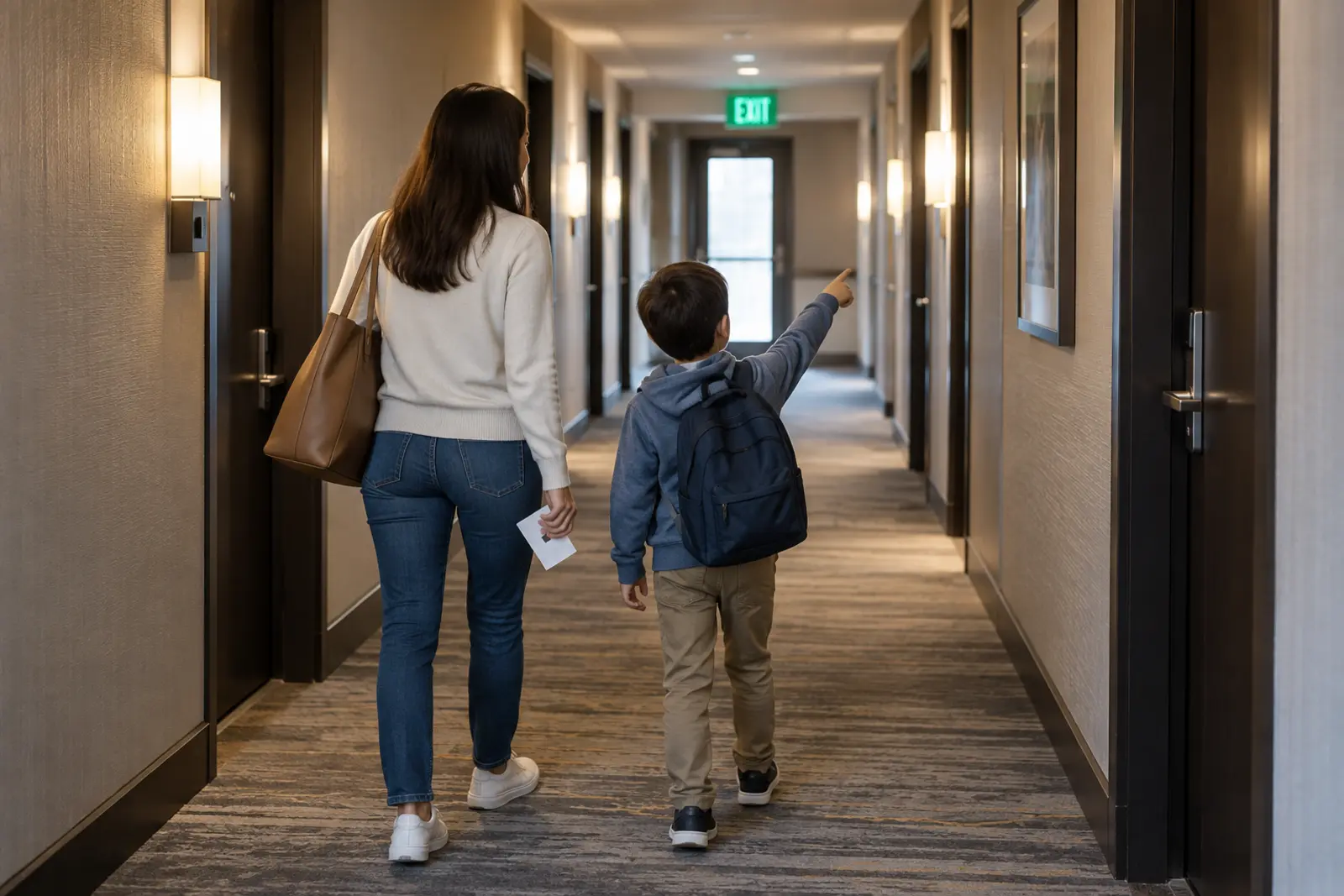
A hotel corridor is unfamiliar by design: similar doors, repeated turns and no family muscle memory. The U.S. Fire Administration tells hotel guests to read the evacuation plan, find the two closest exits, count the doors between the room and those exits, and locate alarms on the floor. Door counts can help when smoke or darkness removes the visual landmarks.
USFA also recommends choosing hotels with hard-wired smoke alarms and automatic sprinklers in each guest room. Vacation and short-term rentals are not regulated to the same extent, so the family should verify smoke alarms, carbon-monoxide alarms, operable exits, extinguishers, the property address and an outdoor meeting place.
The five-minute hotel arrival drill
Minute 0–1: read the room map
Before unpacking, find the posted evacuation plan. Point to the room, primary stair exit and alternate stair exit. Do not assume the elevator lobby is the exit. Ask each child to trace the route with a finger. One adult reads any property-specific instructions because building systems and evacuation directions can differ.
Minute 1–3: walk both routes
Take the room key, close the door and walk to the primary exit. Count the room doors or distinctive turns. Confirm that the door leads to an exit stair and is not blocked. Locate the nearest fire-alarm pull station without touching it. Walk far enough toward the alternate exit to understand the route; do not prop open a stair door.
Children should not run ahead, open stair doors alone or treat alarm equipment as a game. Use one neutral script: “If the alarm sounds, we put on shoes, leave our stuff and go with our adult.” The family hotel-room system can handle luggage zones after this safety check is complete.
Minute 3–4: assign people
Say which adult is responsible for which child. If only one adult is traveling, children hold that adult’s clothing or hand as directed; no one goes back for another person without firefighters. Choose a simple outside meeting place that can be reached without crossing an active apparatus lane, such as a far edge of the property designated by staff. Do not pick “the lobby,” because it may be part of the affected building.
Minute 4–5: set the night position
Keep room keys, shoes and a charged phone within immediate reach of the adult, without blocking the door or creating a trip hazard. USFA’s hotel pictographs specifically recommend keeping the room key near the bed. The key can be useful if the corridor is impassable and the family must return to the room. Glasses, hearing devices, mobility aids and essential medication should have a fixed reachable position.
Do not build a “go bag” that tempts anyone to collect belongings. A room key, shoes and the people are the plan. Keep the path from every bed to the door clear of suitcases, toys, chargers and stroller parts.
If an alarm sounds
- Wake and identify: the adult calls each person by name and takes the assigned child.
- Shoes, key, go: put on the reachable shoes if doing so takes seconds; take the room key and phone only if immediately at hand.
- Check conditions: if a closed door or handle is warm, or smoke blocks the primary route, use the second route. Do not open a warm door.
- Use stairs: USFA and Ready.gov say not to use elevators during a fire unless the fire department directs it.
- Stay low if needed: if escape requires moving through smoke, get low beneath it, follow the practiced route and close doors behind you.
- Meet and report: go to the outside meeting place, call 911 when safe and tell responders immediately if anyone is missing or unable to evacuate.
- Stay out: never re-enter for luggage, pets, medication or another family member. Give responders the exact information.
If heat, smoke or flames block both routes, remain behind a closed door, call 911, give the property name, address, room number and number of people, and follow dispatcher and fire-department directions. The Red Cross advises sealing gaps when possible and signaling from a window. Do not climb from a height or improvise with bedding.
Mobility, hearing and sensory needs
Do not discover on alarm night that a family member cannot use the stairs. Before booking, ask the property how accessible rooms, visual or vibrating alarms, evacuation chairs, areas of refuge and staff assistance actually work. On arrival, tell the front desk what help may be required and ask for the property’s emergency procedure. A generic accessible-room label is not an evacuation plan.
For a child who may freeze, bolt or cover their ears, practice only the first three actions: shoes, adult, door. Use the same words every trip. Hearing devices and glasses stay in the fixed night position. If a child sleeps through alarms, the responsible adult’s job is explicit.
The hearing-protection guide does not apply during sleep; earplugs or noise-blocking earmuffs can prevent a guest from hearing an alarm. If noise sensitivity or medical needs affect sleep safety, ask a clinician and the property about appropriate alerting equipment.
Vacation-rental version
Write the exact street address where every adult can find it. Check for working smoke alarms inside sleeping rooms, outside separate sleeping areas and on each level. USFA advises carbon-monoxide alarms on every level, two ways out of each room and the rental, operable exterior doors and windows, known extinguisher locations and an outside meeting place.
Do not disable an alarm because cooking or steam triggers it. Contact the host or property manager. Do not move beds into rooms without safe exits, lock a required egress window, or let luggage block stairs. If required safety equipment is missing or nonfunctional, document it, contact the operator and change accommodations when the risk cannot be corrected promptly.
Kitchen, chargers and ordinary prevention
Cooking is the leading reported cause of hotel and motel fires in the USFA estimate. Stay with permitted cooking equipment, keep combustible items clear and follow property rules. Never use an outdoor grill, camp stove or fuel-burning device indoors or on a prohibited balcony.
Charge phones and power banks on a hard, open surface with undamaged approved equipment. Do not charge under bedding, on an exit path or with a swollen or overheating battery. Unplug suspect equipment and tell staff. The family power guide covers compatibility; it does not make damaged batteries safe.
The morning reset
Return keys, shoes and aids to the fixed position every night. A child who knows the route on arrival can forget after a day of swimming and late food. Run a ten-second recap: first exit, second exit, meeting place, assigned adult. Do not conduct a surprise nighttime drill in a real hotel.
Who should change or skip the property
Change rooms or properties if exits are blocked, alarms appear disabled, the posted plan is missing or wrong, a required mobility arrangement cannot be confirmed, or the family cannot safely use the available route. A cheaper room or a better view is not worth unresolved egress. For family trips where a hotel adds more stress than margin, the one-day trip system may be the better plan.
Authoritative sources
- U.S. Fire Administration: hotel and vacation-rental fire safety
- USFA hotel fire-safety pictographs
- USFA fire escape planning
- USFA high-rise evacuation guidance
- Ready.gov fire response guidance
- American Red Cross: what to do if a fire starts
MAKE THE WEEKEND COUNT
Useful beats heroic.
Build the day your family can finish well, then leave enough energy for the ride home.
More family plans